
I haven’t attempted to match DMTF tones before, but I’m aware of what they are and I already had some decent audio software. The objective is to download the sound recording “Train Station Recording” from the Items menu after speaking to Shifty McShuffles. A hint is given “Some evidence never shows up by ear, however loud you turn it. Audio tools can show you a recording, not just play it.
For this I’m using Audacity and Friture, both are open source tools. I’m running Windows 11, so to pipe the audio from Audacity into Friture, I’ll be using Virtual Audio Cable, a tool that creates a virtual audio input and output in Windows, which makes it easy to pipe audio from one application into another. A must for Software Defined Radio enthusiest.
A note on Friture: This application creates a Spectrogram, which is used a lot in ARGs to find hidden images and words within sounds.
I played the audio file and waited to see if anything stood out. At some point you can hear a female voice, apparently on a phone and around 1 minute into the recording, you can hear the DMTF tones from the phone. When the tones ended I pressed “stop” in Friture and paused the recording. I also looked up DMTF on wikipedia so that I could get a chart of the frequencies associated with each tone.
DMTF tones: On touchtone (landline) phones, these are the tones you hear when you press a number. Each number (as well as * and #) have a unique tone which is a combination of two frequencies, one high and one low. The low frequencies range between 679Hz and 941Hz and the High frequencies range from 1209Hz to 1633Hz. Human ears can hear between 20Hz and 20kHz (20000Hz), so these tones fall around the midrange area of sound Below is a table of DMTF tone frequencies :
Key Low Frequency (Hz) High Frequency (Hz)
1 697 1209
2 697 1336
3 697 1477
4 770 1209
5 770 1336
6 770 1477
7 852 1209
8 852 1336
9 852 1477
* 941 1209
0 941 1336
#941 1477
A 697 1633
B 770 1633
C 852 1633
D 941 1633
My hypothesis is that I can match what I’m seeing in Friture with the tone table above.
Note the additional A,B,C, and D on the list, these are not common on landline phones, but are present and used by operators and technicians on landline phone networks. Another is the 2600Hz frequency which is famous in Phone Phreaking pre 1990 and used in combination with other tones to get free long distance and used in the famous “Blue Box”.
With the spectrogram stopped, I hovered my cursor over the top and bottom lines on the picture to get an accurate idea of what frequency was being heard. I created the table below, and matched them up the with closest frequencies in the DMTF tones table from above, and came up with the corresponding numbers
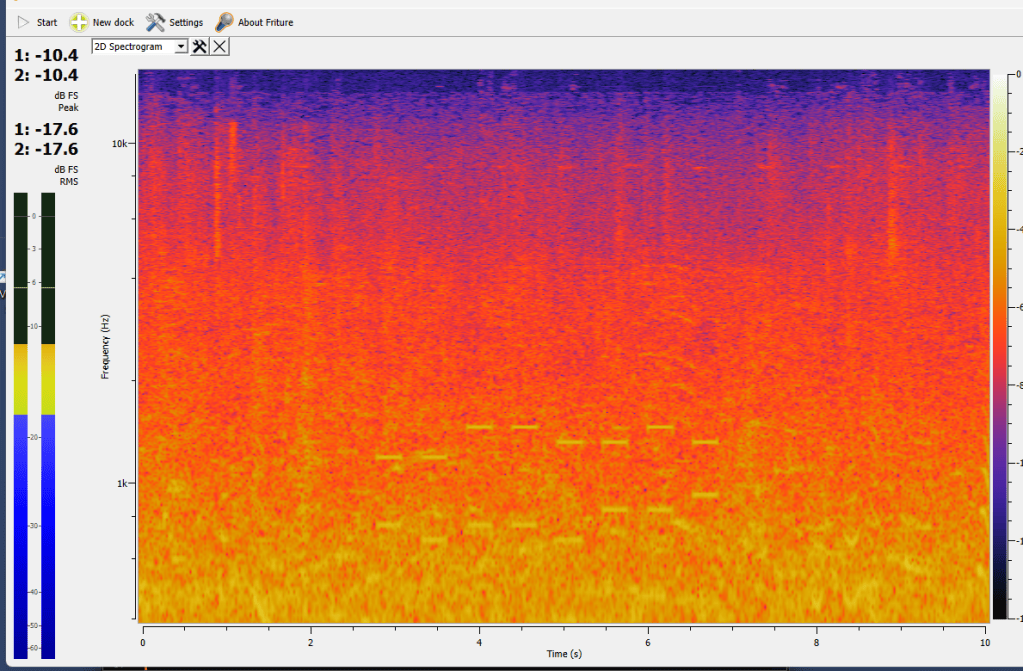
1197 758 4
1197 688 1
1468 754 6
1468 754 6
1325 684 2
1325 836 8
1468 839 9
1325 929 0
I entered 41662890 into the objective and Boom! Objective complete.
The achievement said “Eight digits, pulled out of a whole train stations worth of noise. Angel should really change her PIN.”

