This question drove me crazy for a while. As I read the job descriptions for a threat hunter and compared them to my job as an analyst, I couldn’t figure out how threat hunting was different from what I did. I was asking the wrong question. Not how is TH differed from my duties, but how is TH different from the job duties of a Security Analysts.
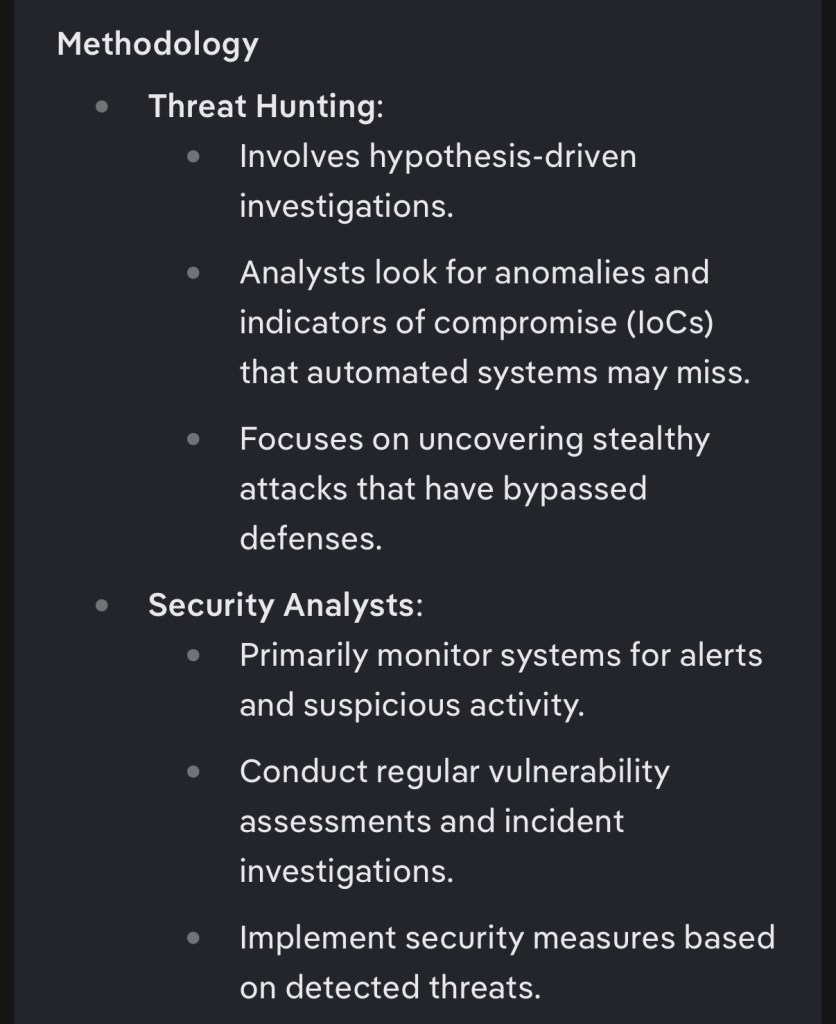
AI finally answered the question because I was forced to ask it the right way. Duck.ai doesn’t know me or my job duties (at least I hope it doesn’t) so the prompt became “how are threat hunters different from Security Analysts” and I realized I was both a threat hunter and a security analyst.
The response:
When I first became a Security Analysts and learned how to use the tools, a thought occurred to me, “How do we know the SIEM, IPS, and AV are catching everything?” And “How can I see what the SIEM might have missed?” Frankly, we had a lot of false alarms at the time and my confidence in the alarm rules set within the SIEM was low. So I decided that once alarms had been investigated and other work was done each day, I would begin searching for potential incidents within the SIEM that the alarm rules may have missed.
The line between analyst, engineer, and threat hunter gets more gray in this area of investigation because I could be doing all three at once. I started with the most likely of intrusions, web app logins. First I checked to see if my “sql injection” alarm was working within the SIEM. I wasn’t expecting an exploit to work, I was more concerned with seeing if the action would trigger an alarm. I made a very basic sql injection line in the username and password field and waited a few minutes. No alarm fired. I then created a search query that would bring up audit logs from the web app between 10mins before my sql injection attempt, until 10mins after, as well as server OS logs and network traffic logs going to and from the web app within the same time frame. I wanted to see what the SIEM could see and what the logs were actually showing. This lead to fixing a silent log source, which was the reason the SQL injection alarm didn’t fire.
I then performed a historic log review of connections to and from the web application within the last 90 days and began checking for possible intrusions by filtering out IPs and services connecting to the server and excluding usernames of the team that actually used the web app (during regular business hours) and found that no intrusions had occurred during the time frame of the silent log source. Of course someone’s account could have been used by an attacker, so I took further steps to ensure accounts created for that time frame were documented in our ticket system, and that no suspicious activity had occurred.
In my mind, I played the part of three roles:
analyst (responding to SIEM alarms/events)
engineer (troubleshooting and fixing problem)
threat hunter (hypothesis = a threat actor could have caused the silent log source or known about it and took advantage, looking for anomalies that automated systems may miss, uncovering stealthy attacks that bypass defenses)
A lot of people, especially those that have worked in very large enterprise networks with hundreds employees in IT and SOC, are quick to say “that’s not part of my job description.” In those large networks where you have public websites with thousands of visitors per hour and hundreds of alarms, this may be true. I imagine many the teir 1 analyst would not be able to check every alarm if they didn’t escalate incidents to the tier 2 analyst or incident response team, and a specific threat hunter is likely the only person with time to investigate more complex attacks that bypass defense measures. The same can be said for CSPs that have a SOC where each member monitors multiple customers, or is required to escalate to the customer’s internal IR team and engineers.
However, most organizations will not have that many people on staff. All of my jobs thus far have been analysts performing the duties of security engineers, threat hunters, vulnerability management, incident response, and assessor for internal assessments. To be honest, I like it this way and I don’t believe we ever had enough work to satisfy that many different titles individually. Note I have worked as a CSP in a customer’s environment, but it was heavily focused on assessment and vulnerability management.
What tools are needed for threat hunting? A powerful SIEM is the most used threat hunting tool, AV, vulnerability scanner, network inventory, ids/ips and/or view access to the firewall. EDR/XDR is always good to have but some claim to do the threat hunting activities themselves.
This brings me to the tools that claim to be Threat Hunting tools, but are actually doing the job of a threat hunter. The issue I have with security tools taking the place of threat hunting is that by definition a threat hunter is looking for threats that the tools have missed. Personally I don’t believe tools should replace threat hunters, but that doesn’t mean the tools shouldn’t be used at all, but rather in conjunction with threat hunters. The more checks and visibility we have, the more secure we are.
This brings me to the current questions all Cyber Security professionals are wondering right now. Will AI replace cyber security employees? There’s no doubt that models with the correct information and the least guard rails are detecting and performing incident response way faster and more efficiently than any human. It is extremely scary, but I think organizations would be crazy to rely only on AI, especially in these early days of AI. SOC teams need to verify what AI is alerting on, and threat hunters need to continue assuming that AI may not catch everything. The media is quick to talk about AI finding zero day exploits but not all zero day exploits are unknown, sometimes it’s a known vulnerability but has never been discovered to work within certain applications.
Symbolic links have been used for years in Unix environments by attackers. It’s common knowledge that symbolic links make up a large number of CVEs and have their own CWE (common weakness enumeration) and new CVEs are being created all the time that fall within that CWE. Recently a number of AI models have been found to have vulnerabilities related to symbolic links. See the following quote from The Hacker News about a new AI vulnerability called GhostApproval:
The attack abuses an old Unix feature called a symbolic link, or symlink, that the assistants fail to check. A symlink quietly points to another file elsewhere on disk, so writing to it actually writes to the target.
https://thehackernews.com/2026/07/ghostapproval-symlink-flaws-could-let.html?m=1
Circling back, I have yet to see AI create a CWE, but it’s very good at creating CVEs based on existing CWEs. On top of that, security researchers are constantly finding new CWEs and CVEs that AI agents and models are vulnerable to. Where am I going with this? AI is a great tool for Cyber Security teams to have, but it shouldn’t take the place of a cyber security team. Again, the more monitoring and visibility we have, the better, but we can’t leave our security in the hands of services that itself is vulnerable to attack.
With that said, I do see a lot of these single purpose jobs being replaced by AI. If a jr analyst has one job of triaging alerts then I foresee AI replacing them. It’s very likely that security analysts and engineers will be a single role with many duties, including verifying results given by AI, but will have the time to perform those duties thanks to AI. The whole reason seperate roles within security were created is because they were needed and it’s possible that some orgs will no longer need individual security roles. Hopefully AI will make our jobs easier in the long run